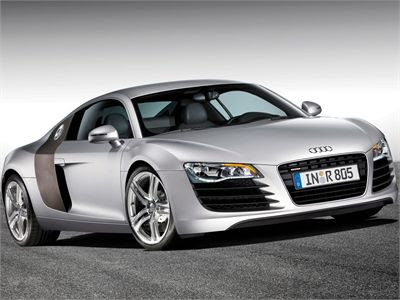
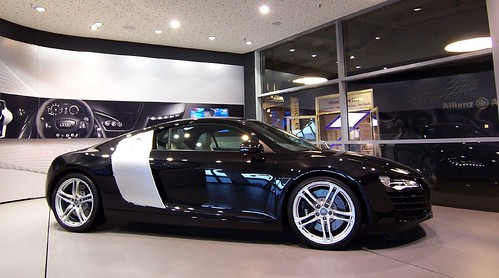
Showing posts with label Audi R8. Show all posts

Saturday, February 26, 2011

MTM Geneva Show Display Includes Fastest Audi R8 with 777HP and TT RS with 472HP


Among the many tuning firms making their way to the Geneva Motor Show is VW Group specialist MTM. The German company will display two heavily modified Audi models, based on the R8 V10 and the TT RS. The most impressive proposal is the one-off MTM R8 Biturbo that comes with a polished chrome body that took over 700 working hours to complete. A large fixed spoiler at the back along with 20-inch forged rims and carbon fiber parts round off the exterior changes.

However, the most striking aspect of the tune is hidden underneath the shiny body as MTM has modified the V10 engine to produce a whopping 777-horses and 888 Nm (655 lb-ft) of peak torque for a 0 to 100km/h (62mph) sprint time of 3.0 seconds. The R8 BiTurbo also accelerates from naught to 200km/h (124mph) in 9.37 seconds and to 300 km/h (186mph) in 19.42 seconds, en route to a top speed 350km/h (218mph).

The conversion also includes an adjustable sports suspension and massive MTM brakes with 8-piston calipers at the front and rear axle. Currently a one-off model, the MTM R8 Biturbo is said to cost over €400,000 or about US$550,500.

MTM's second tuned vehicle is the TT RS that sports a 2.5-liter turbocharged inline-five producing 472-horsepower that was recently tested at Nardo achieving a top speed of 312km/h (194mph).

MTM TT RS
Power output (max.): 472 hp (347 kW) at 7000 rpmTorque (max.): 600 Nm at 4400 rpm
Acceleration 0-100 km/h: 3,9 s
Top speed: 312 km/h
Brakes: MTM brake VA 380 x 34mm, dimpled, 8-piston calipers
Wheels: 20'' MTM Schmiederad im BIMOTO Design
Price: 84.166 Euro (incl. tax and installation)


_______________________________GALLERY_______________________________


Monday, January 10, 2011

The Audi R8 Spyder Latest News And Latest Videos Review

Looking back on the past decade of sportscar racing, there have been many iconic prototype and GT cars that helped shape the era that was filled with close competition and technological innovation.

While Audi will be remembered for its R8 prototype, arguably considered the most successful LMP car of its time, and later conquering Le Mans with diesel-powered machines, the German manufacturers’ sister brand, arguably boasting an even deeper racing pedigree, also left a significant mark in the 2000s.

Seven years since fielding a factory prototype in sportscar competition, Porsche returned to the LMP ranks with an all-new contender in 2005. While many expected the RS Spyder, Porsche’s first purpose-built prototype since the GT1-98, to raise the bar in the evolving LMP2 category, not many could have predicted the level of success it actually achieved.
Porsche engineers Roland Kussmaul and Owen Hayes were instrumental in the RS Spyder's success as well. (Photo: Porsche Cars North America)

The RS Spyder not only conquered its class, but was also one of the first ‘small prototypes’ to take the fight to the bigger and more powerful LMP1 cars in the American Le Mans Series. And much of its success came at the height of the series’ factory prototype involvement, with Audi and Acura also in the battle for top prototype honors.

With 13 overall wins, 35 class victories and 12 championships during its five-year run in the ALMS and select outings in the European-based Le Mans Series and the 24 Hours of Le Mans, the RS Spyder may have not racked up the accolades of the R8, but some could argue it made an even larger impact on the sport.

Audi R8
Audi R8audi r8 wallpapers

The Beginning

As the legacy of the venerable Audi R8 was coming to a close, the story of the Porsche RS Spyder was just beginning. Unveiled in early 2005, the German manufacturer’s re-entry into the prototype ranks proved to be no second-class effort, despite building the car to the second-tier LMP2 specification.

With full works support and famed American entrant Penske Racing running the operation Stateside, there was no shortage of talent from the driver or personnel side. Porsche had entrusted Sascha Maassen and Lucas Luhr, two of its veteran GT factory drivers, and multiple-time ALMS champions, to help develop the RS Spyder, with then-rising stars Timo Bernhard and Romain Dumas also handling testing duties by years’ end.


“When we started to test the car in 2005 we found a lot of problems,” Maassen said. “Everything in the car was new. The engine, the gearbox, the chassis, etc. But the progress we made before the first race was the biggest, even so nobody outside of Porsche realized.”
Sascha Maassen and Lucas Luhr debuted the RS Spyder at Mazda Raceway Laguna Seca in 2005. (Photo: LAT)

The RS Spyder made its debut at the ALMS season-ending round at Mazda Raceway Laguna Seca later that year, with Maassen and Luhr handling driving duties. And despite the steep learning curve, and both drivers’ first-ever prototype race, the duo blew the LMP2 competition out of the water.

“The first race was special,” Maassen said. “We finally had to perform after all the work that was put into the project. I remember having to drive for three hours in the race and my back was hurting as the g-forces were amazing. But I didn’t want to get out of the car! We had pole position, fastest lap and won the LMP2 class that weekend.”

Maassen and Luhr recorded a fifth place finish overall, a feat relatively unheard of for a category that was generally a last-man-standing affair up until Porsche’s arrival. While there may have been a general lack of competition at the program’s start, Penske’s future success arguably helped transform it into category that was stronger and more diverse than LMP1.

Built with a clean sheet of paper at its motorsports base in Weissach, Germany, the car was one of the first new-generation prototypes built to the ACO’s evolving regulations. But with all of its development done in Europe, there were certainly some uncertainties heading into the RS Spyder’s first full season of competition.

“We were all eager for this project,” Bernhard said. “Right from the beginning you could feel the enthusiasm of everybody involved. It showed me that we would be successful. But driving wise, I felt right away that the car had not only big potential but it had already a great balance, which was a great base to start from.”

Prototype racing was also something new for three of its lead drivers, which perhaps turned into Porsche’s advantage. While Dumas boasted a handful of starts for Henri Pescarolo’s outfit and a few races with the Team Nasamax Reynard, the Frenchman knew from his first test at Monza at the end of 2005 that the RS Spyder was in a different league. Dumas credited veteran engineer and former driver Roland Kussmaul for being instrumental in their transition from the 911 to the RS Spyder.
Timo Bernhard and Romain Dumas scored Porsche's first overall victory in American Le Mans Series competition at Mid-Ohio in 2006. (Photo: ALMS)

“From day one, they were able to build the car around us,” Dumas said. “But Porsche were listening a lot to us drivers. That was the key point there. As soon as you were asking for something, it was done a few days later. But a very important part of the circuit was Penske.”

There were ups and downs through the car’s first full season. Mechanical issues at Sebring and a double-DNF on the streets of Houston put a sour note to their championship ambitions, but Penske’s strength shined through in the following round when history was made.

Bernhard and Dumas claimed overall honors at Mid-Ohio, leading home a Penske 1-2 in the first race won by a lighter and lesser powerful LMP2 machine in nearly three years. While it ended up being the duo’s only overall victory of the season, the two-car effort combined for additional six class wins.

While Maassen and Luhr were crowned drivers’ champions in 2006, work was already underway for the next generation of RS Spyder, which debuted at Sebring the following year. It was the same race which Acura took to the stage with its new LMP2 contender. Penske and Porsche’s competition was about to get a whole lot stronger.

The Audi R8 Spyder makes me want to move to California.

A few minutes in the convertible, sun pinking my nose, and I’m ready to trade my life in the blizzard-prone Northeast for earthquakes, fires, state bankruptcy and paparazzi.

Since the Spyder sports car starts at $161,000, I’ll probably have to live in a rundown place in the Valley, but I’ll still be ruling Los Angeles from the Audi’s leather-bucketed throne, with the V-10 engine right behind me.

I’m a fan of the R8 coupe in both 4.2-liter V-8 and 5.2- liter V-10 guises, and was not surprised to see Audi roll out of a topless version. It’s a time-honored -- and bottom-line pleasing -- tradition among makers of exotic cars.

What I didn’t expect was that trading its metal lid for a soft top would also set the rather constrained R8 free. It ditches the Hugo Boss suit and briefcase for board shorts and aviator shades. The convertible looks different, handles differently, and completely changes the perspective from inside the car.

My metallic-brown test model twinkles in the L.A. sunlight as I snap down the freeway at 85 mph, other cars ceding territory to its bright LED running lights. Then, into Beverly Hills for a latte, where I’m one of the tribe. No matter that I’m an arriviste -- so is everybody else.

This R8 has the larger V-10 engine, and it’s arguably more power than you need in a convertible. After all, ditching the top also means that the R8 could no longer function as a weekend racetrack car, a personal fantasy I often entertain on snowy Sundays in New York City.

Manual Shift

In the coupe, I prefer the superfast 6-speed automatic transmission, controlled by behind-the-wheel paddles. You can shift in a tenth of a second. Yet here I’ve got an old-world, six-speed open-gate manual shifter. You have to negotiate the metal stick through a series of open, gaping slots large enough to drop a nickel into.

On the racetrack you lose too much time finding those gears. Yet in the convertible it’s perfect: Passengers in higher-riding cars get to look down into the open cockpit and watch the operation. Every time you shift, there is a soft clink of metal on metal.

Caffeinated, I head for the Angeles National Forest north of the city, a place I’ve always imagined as primeval timberland, but which suffered a terrible fire in 2009, so I find instead spindly copses of flame-touched foliage. What it still offers are thickets of looping ridge-side roads.

Corkscrew Turns

I drive for hours and hours and am never once behind another car. The R8 pulls me relentlessly along, grabbing purchase with all four tires through tight corkscrew turns and open sweepers. The combination of all-wheel-drive, mid-engine layout, manual transmission and big engine is the perfect algorithm for a convertible.

It’s not as stiff as the coupe, true, yet it feels more like motoring. The weight is ideal, and even though I’m shifting mostly between redline at third into fourth, I come nowhere near the limits of the car. If I heard tires shrieking on these narrow roads, it would mean I’d done something grievously wrong.

The brake and accelerator pedals are perfectly situated for blipping the gas as you downshift -- a racing technique used to blend engine speeds and one of those esoteric techniques that’s both pleasing and rare to get right. I do it correctly almost every shift in this car.

There are a few things I’d change. Mostly, I wish the R8 had a “mean” button you could engage, which would open up the engine and allow it to get really throaty and wild, more like the Lamborghini Gallardo from which it is derived. Even when you’re really gunning it, the V-10 is too polite by half. Fine around town, but out here I want to hear myself.

Leg Cramps

The footwell is also cramped, with the left-side dead pedal pushed too far forward, so my left leg cramps. I wish the seats had slightly better lumbar support, too.

In the shadows of the mountains it’s much colder, in the 50s, but it’s below freezing back home so no worries. I’m in a T-shirt with the top down. I get out at the crest of a 7,000- foot ridge, ostensibly to look at the view. I soon give up peering through the smog and just stare at the car.

The Spyder has lost the coupe’s signature side scoops, and you can no longer see the engine itself behind glass. Yet with the top missing, the proportions are better -- wider and more squished. More exotic.

I leave the mountains far to the east of the city. It’ll be a long ride back on highways, along flatland that’s already full of traffic moving at 80 mph. I hurl myself into it, confident in my machine.

No more snow days -- just warm wind in your face. It’s a California dream.

The 2011 Audi R8 5.2 Spyder at a Glance

Engine: 5.2-liter V-10 with 525 horsepower and 391 pound-

feet of torque.

Transmission: Six-speed manual or six-speed automatic.

Speed: 0 to 60 mph in 4 seconds.

Gas mileage per gallon: 12 city; 19 highway.

Price as tested: $171,915.

Best feature: That sense of entitled freedom.

Worst feature: Can we get a bit more noise, please?

Target buyer: The Los Angeles titan.

(Jason H. Harper writes about autos for Muse, the arts and leisure section of Bloomberg News. The opinions expressed are his own.)

To contact the writer of this column: Jason H. Harper at Jason@JasonHharper.com or follow on Twitter @JasonHarperSpin.

Audi R8 Records in 2011 Latest Pictures

Throughout its six year history, the R8 has proven to be one of the most dominant cars in history. Indeed, of all the races it had entered over a seven year period, the R8 lost a mere sixteen races total. Here is a list of some of the achievements of the R8.

* 24 Hours of Le Mans winner - 2000, 2001, 2002, 2004, 2005
* American Le Mans Series champion: 2000, 2001, 2002, 2003, 2004, 2005, 2006†
* European Le Mans Series champion: 2001
* Le Mans Series champion: 2004

† - Season partially run by the Audi R10 as well.

Audi R8
Audi R8

Audi R8
Audi R8

Audi R8
Audi R8

Audi R8
Audi R8


Audi R8
Audi R8

Audi R8
Audi R8

Audi R8
Audi R8

Audi R8
Audi R8

Audi R8
Audi R8


Audi R8
Audi R8

Audi R8
Audi R8

Audi R8
Audi R8

Audi R8
Audi R8

Tuesday, December 21, 2010

Audi Proposes R8 Spyder Car Cover for Unhappy BMW and Mercedes Owners


From the creators of last year's R8 V10 garage door decal promo, comes this new advertising project for Audi. This time, creative advertising agency Lowe Roche, came up with a groovy Audi R8 Spyder car cover aimed at BMW and Mercedes-Benz owners who are disappointed with their vehicles, as well as the rest of us who can't afford [...] Ingolstadt's flagship roadster model.

Here's the description from Lowe Roche's webpage: "Don’t have an Audi R8 Spyder? Now you can pretend to have one. Trick your neighbors, and best of all, trick yourself into thinking you have the car of your dreams. Perfect for the BMW or Mercedes owner in your life filled with regret."

Is it just me, or does the wording make the description sound overly conceited?

Source: Lowe Roche


Unholy Tuning: Audi R8 Sedan Based on A8 Limo


If you were ever wondering what an actuall Audi R8 sports sedan would look like, sorry to say, you're out of luck. However, if by any twisted chance you're interested in finding out what would happen if a first-generation A8 and R8 got naughty in bed, scroll down and check out the rest of the photos. According to the forum members of the Audizine site, the R8-wannabe sports sedan was snagged outside Hooters (now, why aren't we surprised...) in Montreal, Canada.

Source: Audizine


_______________________________GALLERY_______________________________


Saturday, December 11, 2010

R8 Audi photos

new audi r8
audi r8 in orange
audi r8 wallpaper
latest audi r8 car
audi r8 image

Monday, December 6, 2010

Audi R8 Fast and Furious

The Audi R8 (Typ 42) is a sports car with a longitudinally mounted mid-engine, and uses Audi’s trademark quattro permanent all-wheel drive system. It was introduced by the German automaker Audi AG in 2006.

The car was exclusively designed, developed, and manufactured by Audi AG’s high performance private subsidiary company, quattro GmbH, and is based on the Lamborghini Gallardo platform. The fundamental construction of the R8 is based on the Audi Space Frame, and uses an aluminium monocoque which is built around space frame principles. The car is built by quattro GmbH in a newly renovated factory at Audi’s ‘aluminium site’ at Neckarsulm in Germany.

In 2005, Audi announced that the name of the successful Audi R8 race car would be used for a new road car in 2007, the Audi R8, based on the Audi Le Mans quattro concept car, appearing at the 2003 International Geneva Motor Show, and 2003 Frankfurt International Motor Show. The R8 road car was officially launched at the Paris Auto Show on 30 September 2006. There was some confusion with the name, which the car shares with the 24 Hours of Le Mans winning R8 Le Mans Prototype (LMP). 6-time 24 Hours of Le Mans winner Jacky Ickx described the R8 as “the best handling road car today”.

The Audi R8 is used as a safety car in Deutsche Tourenwagen Masters and British Superbike Championship racing series.

Audi R8fast audi r8 and furious
Audi R8concept audi r8
Audi R8audi r8 vages
Audi R8wallpapers of audi r8
Audi R8audi r8 remove
Audi R82009 audi r8 studio
Audi R8audi r8 v12

Audi r8 black Cars

The base 4.2 R8 has a 420 horsepower high-revving V8 engine and all-wheel-drive. It uses the mid-engine Lamborghini Gallardo platform and starts at $114,200, positioning it squarely against the BMW M6, Porsche 911, and Aston Martin Vantage.

The car features a choice of LED or Xenon headlamps surrounded by LED running lights and indicators. LEDs are also used in the engine bay to make the impressive V8 visible even at night.

Both a standard manual and an automated manual transmission are offered. Claimed zero to 62 mph time is 4.6 seconds, though this number is likely conservative.

Interior
The interior has a driver-oriented cockpit architecture, integrating the driver between the dashboard and the high center console. The instrument panel above the console is angled slightly towards the driver. The flat-bottomed steering wheel is a typical feature of the sportiest Audi models, and also enables comfortable sports car entry and exit.

The sports seats are trimmed as standard in a Leather/Alcantara combination, or optionally in full leather. Alternatively, the R8 can also be fitted with bucket seats, specially developed by quattro GmbH. There is plenty of room for the two occupants, with comfort levels well beyond the norm of high-performance sports cars. There is space behind the seats to stow large bags, or even two golf bags. The luggage compartment at the front has a capacity of 100 litres.

With numerous trim variants and applications in Piano finish or Carbon sigma, there are few limits to the range of customization options for the interior.

The drivetrain
At 7,800 rpm the 4.2-liter engine delivers 309 kW (420 bhp) of power output. Peak torque is 430 Newton-meters from 4.500 to 6,000 rpm. And no less than 90 per cent of this maximum torque is maintained consistently throughout a wide engine speed range from 3,500 all the way to 7,600 rpm. As a result of these qualities, the eight-cylinder power unit provides ample thrust in most driving situation.

The engine is a high-revving unit. The maximum engine speed is 8,250 rpm. Two transmissions are available: a manual 6-speed gearbox or optionally the Audi R tronic sequential-shift gearbox, with a joystick gear-shift on the center console and, most especially, the paddles mounted on the steering wheel. 'Shift by wire' technology provides for very fast gear-shifting and an outstanding power-to-weight ratio, allied to compact gearbox dimensions. The Sport mode, with its fast shifting, guarantees the absolute maximum in terms of driving fun. An automatic mode can also be selected.
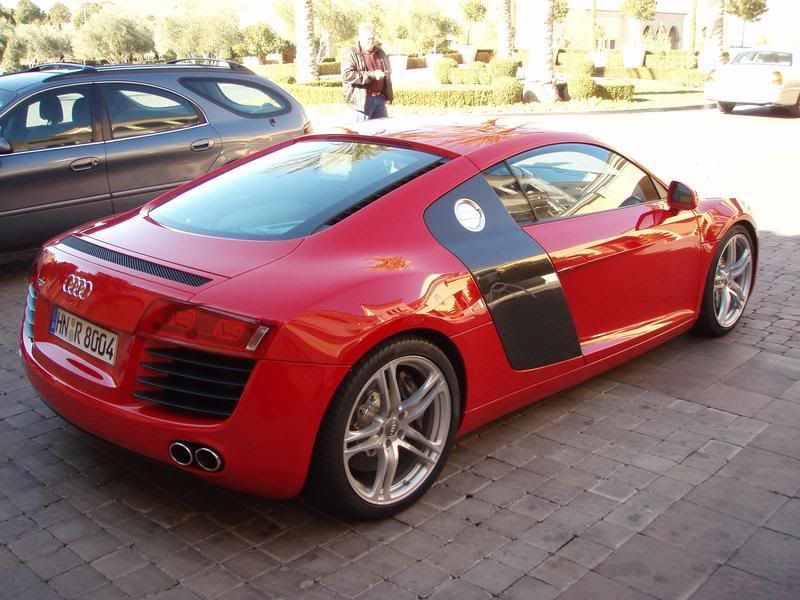
The car is fitted with permanent four-wheel drive, which distributes the power variably to the front and rear axles by way of a viscous clutch. On the Audi R8 the legendary quattro system is adapted to the axle load distribution typical of mid-engined cars.

The chassis
The chassis features forged aluminum double wishbones at the front and rear. At the front they are triangulated, while at the rear the top one is triangulated and the bottom one is a triangulated wishbone with a track rod. This provides for optimum wheel control, and is a geometry which has proved itself to be the ideal solution in delivering agility, maximum steering precision and precisely defined self-steering characteristics.

Direct, hydraulic rack-and-pinion steering provides optimum feedback to assist the driver.

The spring and damper set-up is stiff in order to deliver maximum driving dynamics, while still providing a quite astonishing level of ride comfort. This is particularly true when the 'Audi magnetic ride' adaptive damper system is chosen as an alternative to the standard gas-filled shock absorbers.

Instead of the conventional damper fluid, a magnetorheological fluid is used -- in other words, a fluid whose viscosity can be influenced by an electromagnetic field. This effect enables the damping characteristic to be influenced electronically at will and instantaneously, by applying a voltage to the electromagnets.

Audi magnetic ride uses this property to deliver the correct damping forces in every driving situation. A computer determines the prevailing driving situation in a matter of milliseconds. Drivers can choose from two driving programs depending on whether they want to drive in a highly sporty style -- with the magnetorheological fluid adjusted to a low viscosity -- or with the emphasis more on ride comfort.

The Audi R8 is fitted with 6-arm 18-inch wheels as standard, and can optionally be ordered with 19-inch wheels. The 235/40 size tires at the front and up to 285/35 at the rear provide the necessary road-holding. The mid-engined sports car's long wheelbase and extremely low center of gravity ensure that it always retains maximum stability.

Equipment and trim
Xenon plus lights, LED rear lights and daytime running lights, 18-inch aluminium wheels, an audio system with 7-inch monitor, an anti-theft alarm and Leather/Alcantara interior trim are just some of the items on the extensive list of standard features.

The range of optional extras includes a Bang & Olufsen sound system, featuring an output of 465 watts and 12 specially designed speakers. A microphone-based vehicle noise compensation system adjusts audio levels to changing road conditions and speeds.

The acoustic parking system and a rear-view camera help the driver to maneuver into even the tightest of spaces. The radio/navigation system plus, featuring a large-format color monitor and MMI keypad, combines extensive functionality with extreme user-friendliness.

A total of eight exterior colors are available, from Ibis White to Phantom Black, pearl effect.

Craftsmanship
The Audi R8 is being built on a small-lot production line in a specially constructed new block at the Audi plant in Neckarsulm. The entire production process -- from the bodyshell construction to final assembly -- is organized in the same way as a craft workshop. Small teams of specialists accompany every step of production, ensuring that every one of the maximum of 15 cars per day built is up to quality standards.

Audi r8audi r8 black misc
Audi r82010 audi r8 black
Audi r8audi r8 black spider
Audi r82008 audi r8 black
Audi r8audi r8 black image

Monday, August 16, 2010

Audi R8 V10


At the Detroit motorshow next month, Audi will debut the R8 V10, the fastest production R8 yet. The R8 V10 will come with a 5.2 litre V10 engine producing 528 hp, the same as in the Lamborghini Gallardo LP560-4. This power plant has also previously appeared in the R8 LMS GT3 racer.

Unique to the R8 V10 are the LED headlights for the main and dipped beams, a first, and daytime running lights. A new rear diffuser creating more down force is also special to this model and twin oval tailpipes tag the rear of the V10, as opposed to the quad chrome exhaust of the V8 version.

The V10 also features magnetic ride dampers and comes with a choice of a 6 speed manual or an R tronic semi-automatic gearbox.

The numbers: 0 to 62mph in 3.9 seconds and a top speed of 196 mph.

Inside, you get a Bang and Olufsen system, which, for the average reader, costs about as much as your current car is worth. There's a Nappa leather finish too.

The R8 V10 will cost around £121,800 in the UK.

Press Release:

The Audi R8 5.2 FSI quattro: breathtaking performance

The new 5.2-litre, 10 cylinder engine puts out 525bhp

Sprint to 100 km/h in 3.9 seconds, top speed 316 km/h

High-performance sports car with striking design

Audi is launching the next variant of its top-of-the-line model. With the R8, the brand has established itself at the forefront of high-end sports cars from the very start – and now comes the R8 V10. Its 5.2 litre, ten-cylinder engine churns out 386 kW (525bhp) and 530 Nm (390.91 lb-ft) of torque, which makes for breathtaking performance. With superior Audi technologies such as quattro all-wheel drive, the lightweight aluminum body, the innovative all-LED headlights, and its striking design, the R8 V10 takes pole position against the competition.

The R8 V10 is the result of cumulative know-how from Audi's string of Le Mans victories. Its naturally aspirated engine combines racing technology such as dry sump lubrication with FSI gasoline direct injection. The ten-cylinder design is the perfect synthesis for impressive top performance, mighty pulling power, and low weight. Starting in 2009, this engine will also prove its potential on the world's racetracks – in the new R8 racing car Audi is developing for customer teams in conformance with the GT3 rules.

The V10 engine in the production sports car will be almost identical in construction to the one in the racing version. Its displacement is 5,204 cc, at 6,500 rpm it delivers 530 Nm (390.91 lb-ft) of torque, at 8,000 rpm its power tops out at 386 kW (525bhp).

The specific power output is 100.9bhp per litre of displacement – and each hp has to propel only 3.09 kilograms (6.91lb) of weight, because the Audi R8 V10 in the version with the six-speed manual gearshift weighs only 1,620 kilograms (3571 lb). The engine accounts for 258 of these kilograms (569lb) – that's only 31 kilos (68lb) more than the V8.

The Audi R8 5.2 FSI quattro rockets from zero to 100 km/h (62.14 mph) in 3.9 seconds. In the version with the sequentially shifting R tronic it reaches 200 km/h (124.27 mph) in another 8.1 seconds. Even then its propulsive power hardly lessens: it's sufficient to reach a top speed of 316 km/h (196.35 mph). The immense force, the spontaneity and the thrust of the acceleration, plus the sound of the engine – all these impressions coalesce into a breathtaking sports car experience. The V10 plays a concert with growling bass tones and powerful high notes, which grows into a grandiose fortissimo as the engine revs up. This sonorous acceleration doesn't reach its limit until 8,700 rpm.

The 5.2 litre powerplant uses direct injection according to the FSI principle developed by Audi. A common rail system injects the fuel into the combustion chambers with up to 120 bar of pressure. Direct injection reduces the susceptibility to knocking and provides a certain amount of cooling through the evaporation of the fuel, which in turn supports a high compression ratio of 12.5:1. This in turn contributes to superior performance and improves fuel economy. The R8 V10 with R tronic gets by on an average of 13.7 litres per 100 km (17.17 US mpg).

For maximum dynamics: low centre of gravity engine:

The technical refinements of the long-stroke ten-cylinder engine include dry sump lubrication, which allows the engine to be mounted low within the chassis. The wide cylinder angle of 90 degrees also makes for a low center of gravity.

The crankcase is a high-strength aluminum-alloy casting produced in a complex process. The connecting rods are made of forged steel, the pistons of aluminum. The four camshafts are chain-driven and each is adjustable through 42 degrees. This provides great latitude in controlling the valve timing. In combination with the straight, flow-optimized ducts of the intake manifold, this improves the charge throughout the entire speed range.

The R8 5.2 FSI quattro has a six-speed transmission. A precise and smooth-shifting manual transmission comes as standard equipment. The sequential R tronic is available as an option. The high-tech gearshift conveys an authentic racing feel – with the rocker switches at the steering wheel and the short shifting times of usually less than one-tenth of a second. When the driver actuates the Launch Control program by pressing a button, the R8 V10 takes off in a vehement quick-start with electronically controlled tire slip – both with the R tronic and with the manual transmission.

A contributing factor to the wide lead in traction and driving safety of the Audi R8 V10 over the competition is quattro all-wheel drive – it's the superior technology especially for a high-performance sports car. Four powered wheels get more grip than two. They enable the driver to step on the gas sooner when coming out of a curve. It's not only the traction that benefits, but also the transverse dynamics and the stability 44 to 56 percent – the ideal axle load distribution.

The Audi R8 chassis offers both dynamic performance and astonishing levels of comfort on long distances. This high-performance sports car from Audi eagerly responds to any steering action with instant ease, achieves lateral acceleration of up to 1.2 g, and handles any situation with superb driving safety. Its mid-engine design provides an ideal axle load distribution of 44 to 56 percent.

The wheel suspensions on dual aluminum wishbones front and rear – a classic racing technology – are optimized for neutral self-steering characteristics. Even more than in the eight-cylinder R8, this setup is designed for maximum performance. 19-inch wheels equipped with tyre pressure monitoring display are standard equipment. Their 10-spoke Y design is exclusive to the R8 V10. Tyre sizes are 235/35 front and 295/30 rear.

The car features a high-end damper technology as standard:

Audi magnetic ride adapts the characteristics of the suspension in milliseconds to the nature of the road surface and to the driving style. Suspended in the oil of the shock absorbers are tiny magnetic particles which, when a voltage is applied, rearrange themselves so as to slow down the flow of oil through the valves .In the R8 V10, deceleration is provided by an extremely muscular braking system – eight brake pistons at the front and four at the rear grasp the brake disks, which are ventilated and perforated to ensure unimpeded heat transfer. The brake disks on the front axle have a diameter of 380 millimetres (15 in); the rear discs span 356 millimetres (14 in).

The R8 5.2 FSI quattro is optionally available with a ceramic brake system whose disks are made of a composite material containing high-strength carbon fibers and abrasion-resistant silicon carbide. These are especially light: their combined weight is nine kilograms (19.84lb) less than the weight of equivalent steel disks. The ceramic brakes can easily cope with the harsher requirements of racing, won't corrode, and have a typical service life of 300,000 kilometres (186,400 miles). Their calipers are painted charcoal gray and emblazoned with the inscription "Audi ceramic".

Typically Audi:

Sharp lines and an elegantly curved roof:

The wide, full shape of the R8 5.2 FSI quattro seems to hug the road. The brawny proportions and prominent wheel wells underscore its potential. The high-precision styling of the lines and the elegant curve of the roof are typical Audi features. A continuous contour optically connects the front, the wheel wells, the sides and the rear. Located well forward, the cab visually expresses the mid-engine design. The vertical air scoops (sideblades) on the sides are also indicative of the engine location. The massive aluminum gas cap is mounted flush within the right sideblade.

The design of the Audi R8 has already impressed experts, as evidenced by the double victory in the "World Car of the Year Awards 2008". In the ten-cylinder model, the styling has been sharpened up even more. The front air inlets, which feed air to the coolers, and the lip of the front apron are painted in high-gloss black. The number of cross-braces has been reduced from four to two. The vanes of the single-frame grille have a striking chrome finish.

A very distinctive highlight of the R8 V10 are the all-LED headlights as standard equipment. Audi is the world's first automaker to use LEDs for the high beam, low beam, daytime running lights, and turn signals. Each headlight integrates 54 of these high-tech light sources. With a color temperature of 6,000 Kelvin the LED light closely resembles daylight, which is less tiring to the eyes in night driving. Further advantages of the LEDs include brilliant illumination, low energy consumption, and a virtually unlimited service life.

Special details also distinguish the body of the R8 V10. Its sideblades are more accentuated than in the eight-cylinder version. The side sills are more striking and wider; the exhaust grilles at the rear windows have a matt aluminum look. Through the large rear window, the ten-cylinder engine is clearly visible in its consummate technical beauty.

When in motion, this Audi high-performance sports car creates a downforce that keeps it in firm contact with the road – thanks to a rear spoiler which deploys automatically at 100 km/h and the fully enclosed underbody, which terminates in a sharply upward-curved diffuser. The dominant color at the rear end is high-gloss black, including the settings of the LED tail lights. The air outlets at the rear end also have only two cross-braces, and the exhaust system terminates in two large oval tailpipes.

Audi sets the example – in body weight and rigidity:

The body of a sports car must be especially lightweight and rigid. Audi meets these requirements with the technology of the Audi Space Frame (ASF) and its high-tech aluminum construction. The body-in-white of the R8 V10, which includes an engine frame made of ultra-light magnesium, weighs only 210 kilograms (463lb), and the quality of its lightweight design – the relation of weight to torsional rigidity – is the best in the sports car segment. The body is composed of profile extrusions, sheet aluminum and very complex gusset castings, all held together by 99 metres (325 ft) of welding seams, 782 rivets, and 308 special screws.

The interior of the R8 V10 provides a unique racing ambience at the luxury level. Its dominant element is the so-called monoposto – a wide arc that contains the steering wheel and the cockpit. As always in an Audi, the workmanship is of the highest quality. The surfaces of the dashboard and doors are lined with fine materials and adorned with precisely stitched decorative seams.

Many customising solutions are available:

Audi supplies leather in a wide range of colors, packages with a carbon and piano-lacquer finish, or a made-to-measure luggage set. quattro GmbH, which has developed and is producing the R8 V10, also provides solutions for unconventional requirements. The great everyday utility of the Audi R8 V10 is based in part on its spacious interior made possible by the long wheelbase of 2.65 metres (8.69 ft). Drivers and passengers of any size will always find a perfect sitting position. Visibility too is surprisingly good. Slender hinge pillars optimize the obliquely forward field of view. Another advantage for convenient everyday use is the luggage space: 100 litres (3.53 cu ft) fit under the front hood, another 90 litres (3.18 cu ft) can be stowed behind the seats. There is also room for two golf bags.

The Audi R8 5.2 FSI quattro combines its colossal performance with a generous complement of standard equipment. Highlights include heatable seat covers made of Fine Nappa leather, a driver information system, the navigation system plus and the Bang & Olufsen sound system along with deluxe automatic air conditioning and an alarm system. The instruments and the gearshift knob are decorated with red rings; the footrests and the rocker switches of the R tronic have an aluminum finish.

The list of options includes other highly attractive features – such as the Audi parking system advanced with its integrated rearview camera or numerous Audi exclusive customization options. Various leather packages provide a luxurious touch, while the bucket seats from the Audi exclusive program bring a highly concentrated racing atmosphere into the R8 V10. The Audi R8 5.2 FSI quattro will be rolled out in Germany in the second quarter of 2009 at a basic price of €142,400.